


Digital accessibility in marketing ensures everyone, including people with disabilities, can access and engage with your content. Guided by WCAG standards and ADA laws, it improves user experience, SEO, and brand trust while reducing legal risks.
Marketing plans often begin with identifying your target audience. Only after you have clearly established your target audience can you begin planning your marketing strategies and tactics effectively. And with audiences becoming more diverse, integrating accessibility in digital marketing campaigns is not just about moral and legal compliance; it is pivotal for your business’s growth and survival.
But first…
What Is Digital Accessibility?
Digital (or web) accessibility, simply put, is the practice of creating digital materials that are accessible to people with disabilities. These disabilities could be physical (visual or motor impairments) or cognitive (ADHD, etc.)
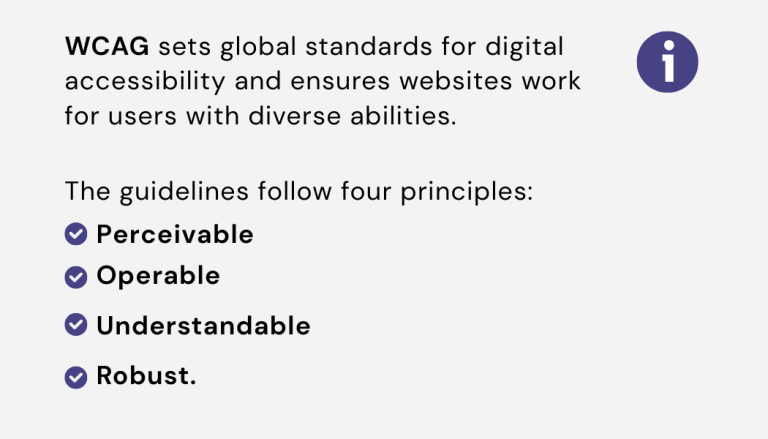
The World Wide Web Consortium (W3C) developed a set of standards through its Web Accessibility Initiative (WAI) that guides the development of accessible content on the web. Those standards are known as the Web Content Accessibility Guidelines (WCAG).
These standards serve as a web accessibility bible of sorts, proffering best practices for developers and web authors to follow when creating content for the web. With these guidelines set, various governments set their regulations to ensure the web is accessible by enforcing WCAG compliance and ensuring website accessibility compliance for organizations.
What is Accessibility in Digital Marketing?
Accessibility in digital marketing means ensuring that every piece of your marketing (website, social media post, email, etc.) can be understood and engaged with by everyone, including people with disabilities. It’s about removing barriers that might prevent someone from accessing your message, product, or service.
When marketing is accessible, it doesn’t just meet compliance standards; it shows that your brand values inclusion and aims to communicate with the broadest possible audience.
Accessibility in digital marketing also means implementing ADA compliance for websites and considering ADA in digital marketing strategies that ensure every customer has equal access to your brand’s digital experience.
Why is digital accessibility important in marketing?

Digital accessibility is important in marketing because it allows every customer to fully experience and interact with your brand, regardless of ability. When your digital campaigns, ads, and websites are accessible, you not only expand your audience but also strengthen trust and loyalty.
Here’s why accessibility should be at the core of every marketing strategy:
- Reach a wider audience: Make your campaigns inclusive of the millions of people with disabilities who engage online.
- Enhance user experience: Accessible design often improves usability for everyone, not just those with disabilities.
- Boost SEO performance: Search engines favor well-structured, accessible websites with optimized media and clear navigation.
- Protect your brand legally and ethically: ADA and WCAG compliance reduce the risk of lawsuits and demonstrate social responsibility.
If you are wondering “what is the ADA?”, it refers to the Americans with Disabilities Act—a U.S. law that protects the rights of people with disabilities and requires equal access to public spaces, including websites and digital content. - Build trust and reputation: Inclusion signals that your brand values all customers, strengthening loyalty and credibility.
Accessibility in Digital Marketing in 2025

In the diverse marketplace of 2025, accessibility isn’t just a compliance issue; it’s a growth strategy that connects your message to more people, more authentically.
With new standards like WCAG 2.2 and stronger enforcement of global regulations such as the ADA in the U.S. and the European Accessibility Act (EEA) across the EU, accessibility has become a key measure of digital maturity.
Brands that fail to prioritize it risk more than lost customers; they face legal exposure, accessibility complaints, and reputational damage.
Accessibility in digital marketing plays a crucial role in building inclusive strategies that drive sustainable engagement and loyalty. In 2025, accessible design and content are also recognized as part of broader ESG and DEI commitments, reflecting a brand’s dedication to equality and responsible innovation.
However, the sad reality is that a significant demographic is still constantly being excluded from digital marketing target audiences, even in 2025. When you design even one ad campaign or create a website copy that isn’t accessible to people with disabilities, you’re directly excluding them.
Aside from breaking compliance, perhaps more importantly, you are indirectly showing that your brand doesn’t care about its corporate, social, and moral responsibilities. This not only limits your potential reach, but it could also hurt your brand image and land you in a lawsuit.
So, what should you, as a digital marketer, do? Here are some best practices to help you integrate accessibility into your campaigns.
In 2025, accessibility is a growth strategy, and tools like Equally AI help marketers create inclusive websites and campaigns that reach every audience.
How To Make Your Digital Marketing Campaigns Accessible
Marketers use a number of platforms and means to deploy their strategies and campaigns. A good knowledge of the rudiments of accessibility is quite important for any marketer who wishes to create wholesome and accessible experiences for their audience.
The use of alternative text (ALT text) for images helps people with visual impairments to make sense of images on the web, transcripts for video and audio material help people with hearing impairment, and the right combination of colors can simultaneously help people with color blindness and distraction-prone disabilities.
It could seem like you have your work cut out for you, but when you initiate a creative process with accessibility on your mind, it helps to make the entire development process seamless.
Provide descriptive alternative ('alt') text for web images
Alternative text describes the contents of an image and comes in handy for people with impaired vision, who can use a website screen reader to “read” the image. If an image doesn’t have alt text, it’s inaccessible to these types of people.
To change or improve alt text, simply choose to edit image options, then add alt text where indicated. It’s best to go with a contextual, straightforward description of the image. So, if you’re featuring an image of a cat playing with a ball, then your alt text might look something like: <img src=”blackcat.jpg” alt=”Black cat playing with a ball”>.
Include transcripts and captions for multimedia content
By including transcripts and closed captions in your ads, you make it easy for those with audio or visual impairments to have an enhanced experience of the advertisement. You can easily record a voiceover using a voice-over generator and have it run in the background of a video ad. For subtitles, Facebook added a new caption feature to add captions to your videos in just a few clicks. You can also preview and review the captions that are auto-generated for videos prior to publishing.
Use accessible design elements
The right colors are key to providing a wholesome experience for users. But what are the right colors? In order to accommodate people with color vision impairment, the color contrast ratio must at least meet the minimum contrast requirement.
There are tools online to help you determine the right contrast ratio, like the WebAim contrast checker. The use of intuitive elements and labeling on your posters and landing pages will help provide context and clarity to people using screen readers to access your website.
Leverage web accessibility solutions on your website
Automated accessibility solutions like Equally AI can help make your website accessible. Equally AI is simple to use and comes with powerful technology that enhances your website’s background and foreground elements.
Equally AI has an Accessibility Assistant with five ready-made accessibility profiles for people with disabilities. Blind (screen reader), Vision impaired, Motor impaired, Seizure secure, and Focus (ADHD). By installing just one line of code, your website can receive an accessibility facelift, better brand perception, and improved SEO.
Ready to explore digital accessibility?
Closing Thoughts
A good number of websites don’t prioritize accessibility, and millions of disabled users suffer as a result. The Pew Research Center found that disabled Americans are three times as likely as non-disabled Americans to say they never go online. But with all hands on deck, we can help change that story and include people with disabilities. It’s not just the right thing to do; it’s mandated by the law.